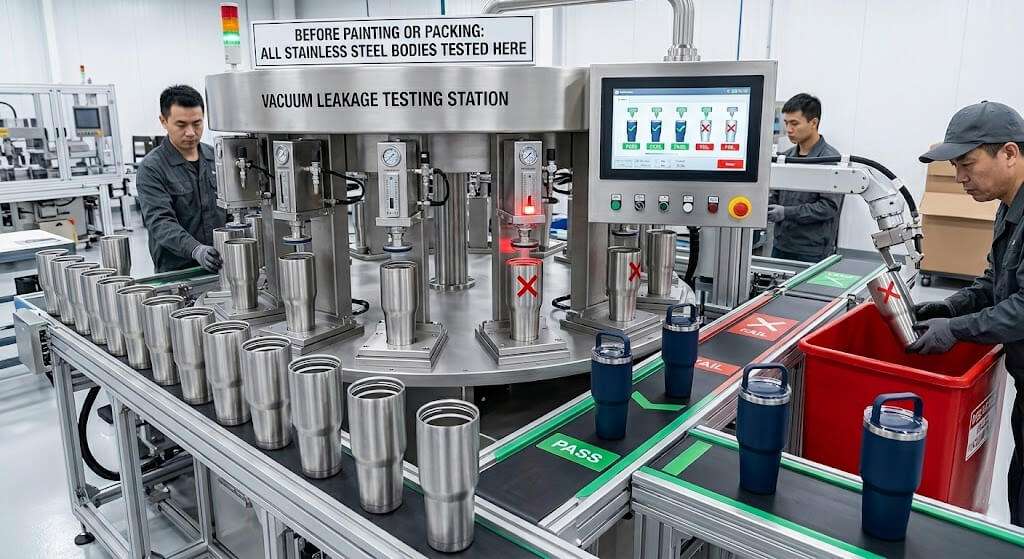
Answer: “Leakproof” should be treated as a testable product requirement, not a universal marketing label. The QC plan should define fill level, closure method, test orientation, duration, pressure or movement conditions, acceptable leakage, sample size, and whether straw or vent openings are included.
For brand and wholesale buyers: JOOYO Drinkware can align lid-fit and leakage checkpoints with the approved sample and written purchase-order standard.
We talk to supply chain managers every day, and regardless of the market, their biggest headache is always the same: leaking bottles. When you are shipping thousands of units to North America or Europe, a faulty seal isn’t just a minor defect—it means costly returns and damaged brand trust.
At JOOYO Drinkware, we don’t leave this to chance. Built into our Wuyi manufacturing facility is a systematic approach to quality control. We want to be completely transparent about how we work. Here is exactly what happens on our factory floor to make sure your custom drinkware stays completely leak-proof.
It Starts with the Thread, Not the Silicone
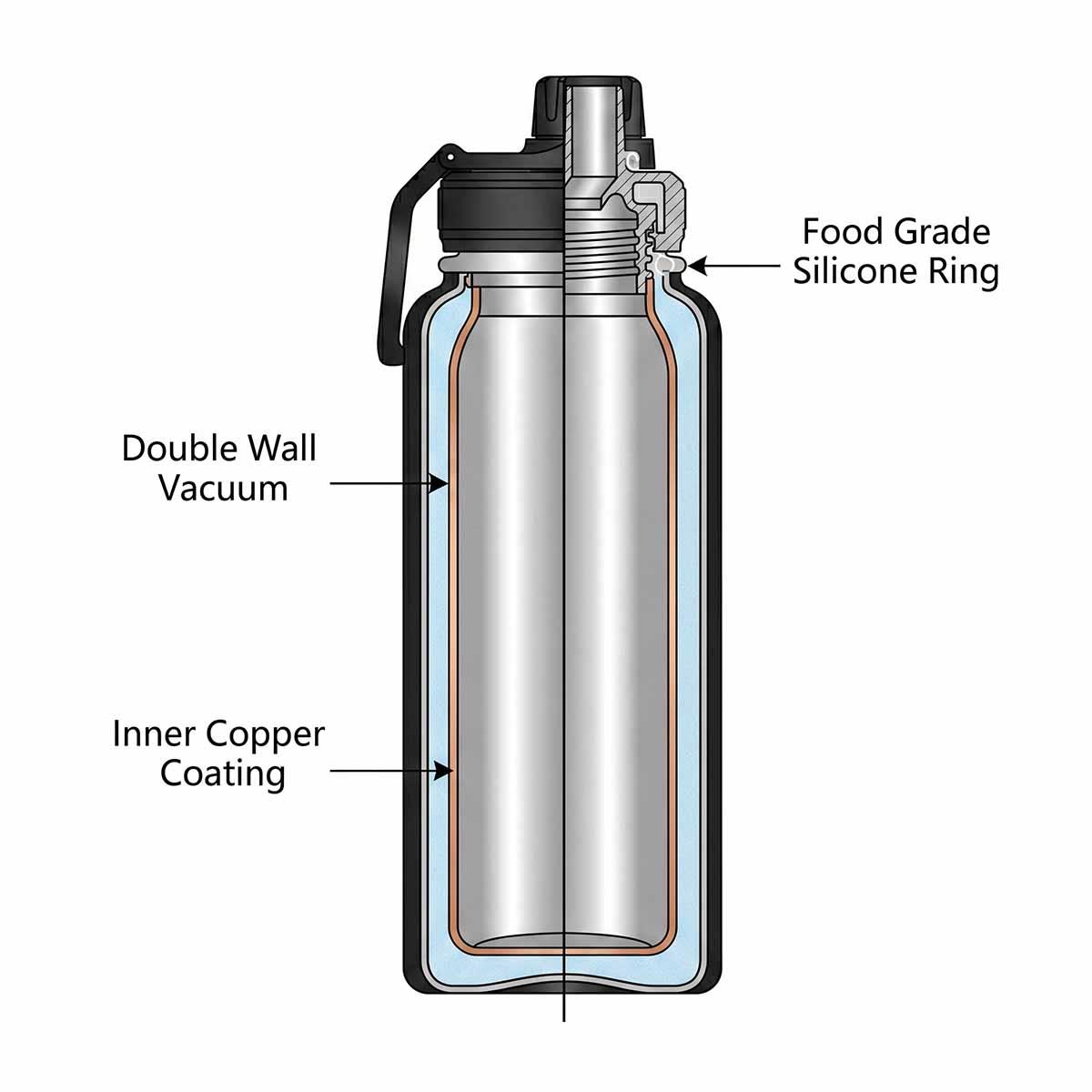
A common misconception is that a thick silicone ring solves all leaking issues. The reality is that a truly leak-proof bottle starts in the CAD software.
A lot of leaks happen because the thread tolerance between the stainless steel body and the lid is even a fraction of a millimeter off. Through our Zero-Tooling ODM process, we calculate and test this fitment digitally and physically before any mass production begins. If the thread geometry isn’t perfect, no amount of silicone will fix it.
Testing on the Line: Step-by-Step
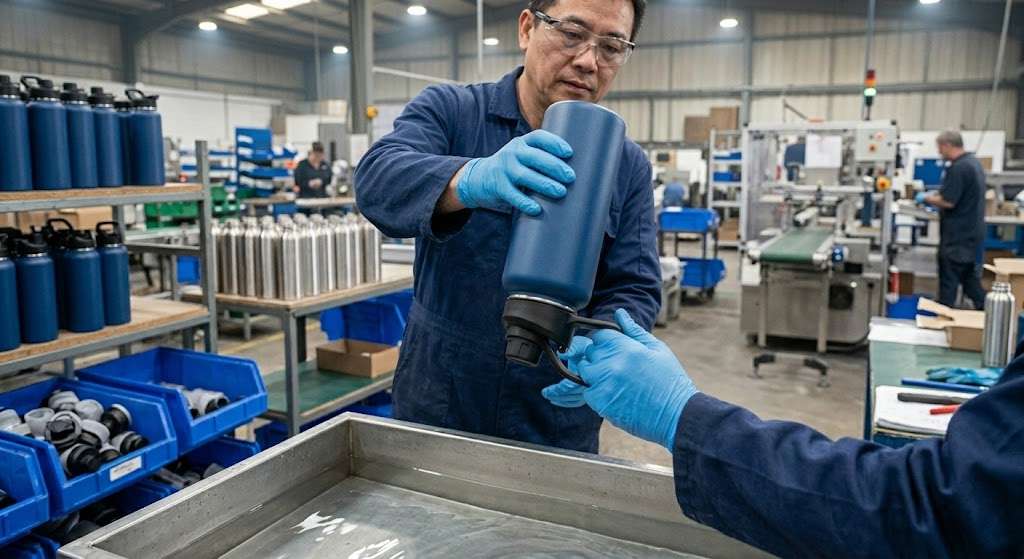
Managing a 10,000-square-meter facility with automated lines requires strict, repeatable standards. Since achieving our HACCP certification, our QC isn’t about random spot-checking; it’s an integrated part of the line. Here is how we stress-test the products:
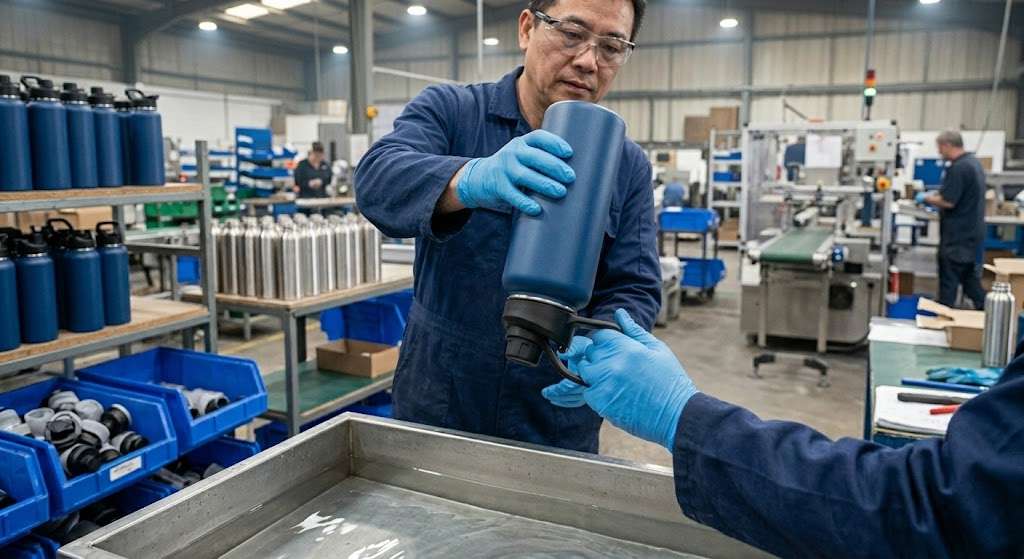
1. Negative Pressure Testing Visual inspections aren’t enough for B2B standards. We use industrial negative pressure testing machines directly on the assembly line. By creating a vacuum environment around the sealed bottle, the machine can detect microscopic air leaks in the dual-wall structure or the lid fitment in seconds. It’s a simple pass or fail: if air escapes, liquid will too.
2. Thermal Shock on Silicone Seals Cheap silicone hardens and fails after holding hot coffee for a few months. We exclusively use FDA and LFGB-grade materials. To prove their durability, we subject prototype seals to thermal shock tests—essentially freezing them, then exposing them to boiling temperatures to ensure the O-ring maintains its elasticity under stress.
3. The Vibration & Inversion Check In the real world, bottles get tossed into gym bags and rattle around in car cupholders. To simulate this, we place filled sample bottles upside down on high-frequency vibration tables for extended periods. If a single drop of water hits the test paper beneath them, the entire batch is pulled for review.
4. Torque Measurement This is a detail many buyers miss. How hard does your customer have to twist the cap to seal it? If it requires too much force, it’s frustrating; if it’s too loose, it leaks. Our team uses torque meters to find the exact rotational force needed for a secure seal, standardizing that “sweet spot” across the entire production run.
Looking for a Reliable Manufacturing Partner?
When you are dealing with custom branding, powder coating, and complex OEM projects, the baseline must always be a fundamentally sound product. We focus strictly on high-quality stainless steel drinkware because specialization brings reliability.
If you’re tired of dealing with inconsistent quality and want to work with a factory that takes QC seriously, let’s talk.
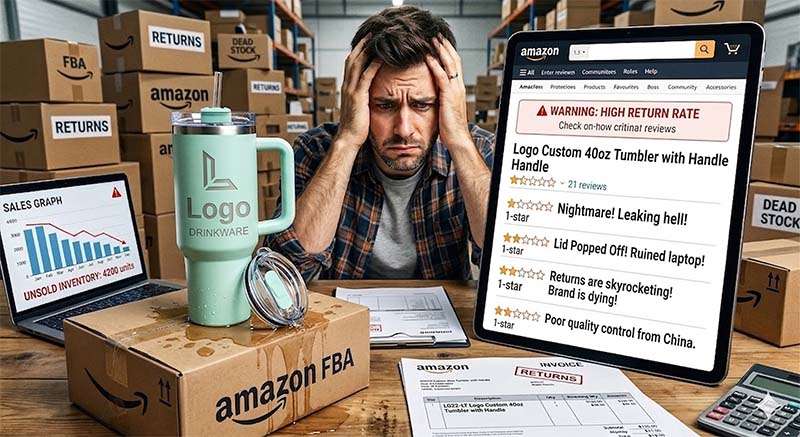
Once products are shipped or in FBA, leakage becomes a return and review problem—not a fixable issue.
Call to Action – CTA
Stop risking your brand’s reputation with unreliable suppliers. Whether you are scaling your Amazon FBA business or sourcing corporate gifts, you need a manufacturing partner who treats your quality as their own.
Ready for 100% leak-proof, premium stainless steel drinkware? Explore our top-rated, customizable products ready for bulk production:
Leak risk is controlled through lid fit, gasket compression, thread tolerance, straw opening design, pressure checks, upside-down testing, and final inspection. For B2B orders, buyers should approve a functional sample and define acceptable leak-test criteria before mass production.
JOOYO Drinkware supports B2B buyers sourcing custom stainless steel water bottles, tumblers, travel mugs, and coffee mugs from Wuyi, Zhejiang. Projects can include product selection, sample coordination, packaging options, ODM support, and buyer-requested material, food-contact, quality-control, or factory documentation where applicable.
Buyer FAQ
Can JOOYO Drinkware support custom stainless steel drinkware projects?
Yes. JOOYO Drinkware supports custom stainless steel drinkware projects including colors, branding, packaging, sample coordination, and ODM support based on the selected product and order requirements.
Can compliance or testing documents be arranged?
Buyer-requested material, food-contact, quality-control, or factory documentation can be supported where applicable to the product, destination market, and purchase order.
Where is JOOYO Drinkware located?
JOOYO Drinkware is based in Wuyi, Zhejiang, China, and serves B2B buyers in the U.S. and European markets.
WhatsApp us
JOOYO Drinkware Free Custom Tumbler Box Dielie
GET IN TOUCH
Wait! Don't Miss the Zero-Tooling ODM Catalog.
Fast-track your custom stainless steel drinkware launch. Enter your email to get our complete catalog and direct-from-factory pricing sent straight to your inbox.