How to Source Pressure-Safe Insulated Bottles: A 2026 Lid and Stopper Test Guide
Pressure buildup is not the same problem as leakage. A bottle can hold still water without dripping and still become dangerous when pressure accumulates behind the closure. In July 2025, the U.S. Consumer Product Safety Commission (CPSC) recalled about 850,000 Ozark Trail 64 oz insulated bottles because lids could eject after certain contents were stored over time. In April 2026, CPSC announced a Thermos recall covering about 5.8 million food jars and 2.3 million Sportsman bottles; the notice identified stoppers without pressure relief and reported 27 incidents.
For brand owners, importers, marketplace sellers, and outdoor drinkware buyers, these events expose an RFQ gap: “leakproof” is specified, but pressure behavior is not. Evaluate the complete container, closure, intended contents, foreseeable misuse, and opening sequence—not just the gasket.
Five Pressure-Related Failure Cases Buyers Need to Control
1. The still-water leak test passes, but trapped pressure is never tested
An inversion test can find a missing gasket, poor thread fit, or assembly error. It does not show what happens after carbonated or perishable contents remain sealed. CPSC’s 2025 notice says the lid could eject after food, carbonated drinks, juice, or milk had been stored over time. That is a distinct pressure scenario, not a stricter leak test.
2. The stopper has no controlled pressure-relief path
The 2026 Thermos recall describes affected stoppers as lacking pressure relief in the center. Stored energy can release abruptly as the closure moves. Approving only the body, gasket, and leak result may miss the feature that controls pressure during opening.
3. A warning label is used to compensate for an unexamined design
Instructions matter, but they should not replace engineering review. Large bottles may hold sports drinks, juice, or food even when a listing says “water only.” The EU General Product Safety Regulation (GPSR) requires safety assessment to consider product characteristics, warnings, consumer categories, and normal or reasonably foreseeable use. EU buyers therefore need a documented risk analysis, not only carton copy.
4. The lid and body are approved as separate components
OEM programs often combine an existing body with a new cap, handle, gasket, or stopper. Acceptable parts can still create insufficient thread engagement, inconsistent opening torque, a blocked vent, or sudden seal release. Test the exact lid, neck finish, gasket, and assembly settings approved for the SKU.
5. The sample is safe, but the production lot is not traceable
A golden sample cannot reveal later resin changes, gasket drift, tooling wear, mixed lid cavities, or altered torque. Without links from a finished bottle to the lid batch, material lot, assembly date, and inspection record, defect isolation becomes slow. GPSR Article 9 also requires type, batch, serial, or equivalent product identification in the EU.
Why Suppliers Miss Pressure-Ejection Risk
The usual cause is an incomplete specification. “Leakproof stainless steel bottle” describes an outcome, not a safety test. A factory may run a familiar inversion test while the buyer assumes it covers every closure hazard. Responsibility fragments further when different vendors supply the body, lid, gasket, and packaging.
Pressure risk often appears under foreseeable time, temperature, contents, orientation, or assembly conditions that are inconvenient to reproduce. Suppliers may also treat a lid change as cosmetic. A new stopper, gasket, vent geometry, or thread dimension is functional and should trigger revalidation.
A Measurable Sourcing and Testing Guide
- Build a use-and-misuse matrix. List sizes, closure variants, intended and prohibited contents, fill level, storage time, temperature, orientation, and opening method. A qualified product-safety laboratory should define safe conditions. Never improvise pressure tests outside a shielded lab.
- Request closure drawings and a component bill of materials. Identify the pressure-relief path, thread engagement, gasket dimensions and hardness, stopper retention, valve parts, and critical tolerances. Lock the revision in the purchase order.
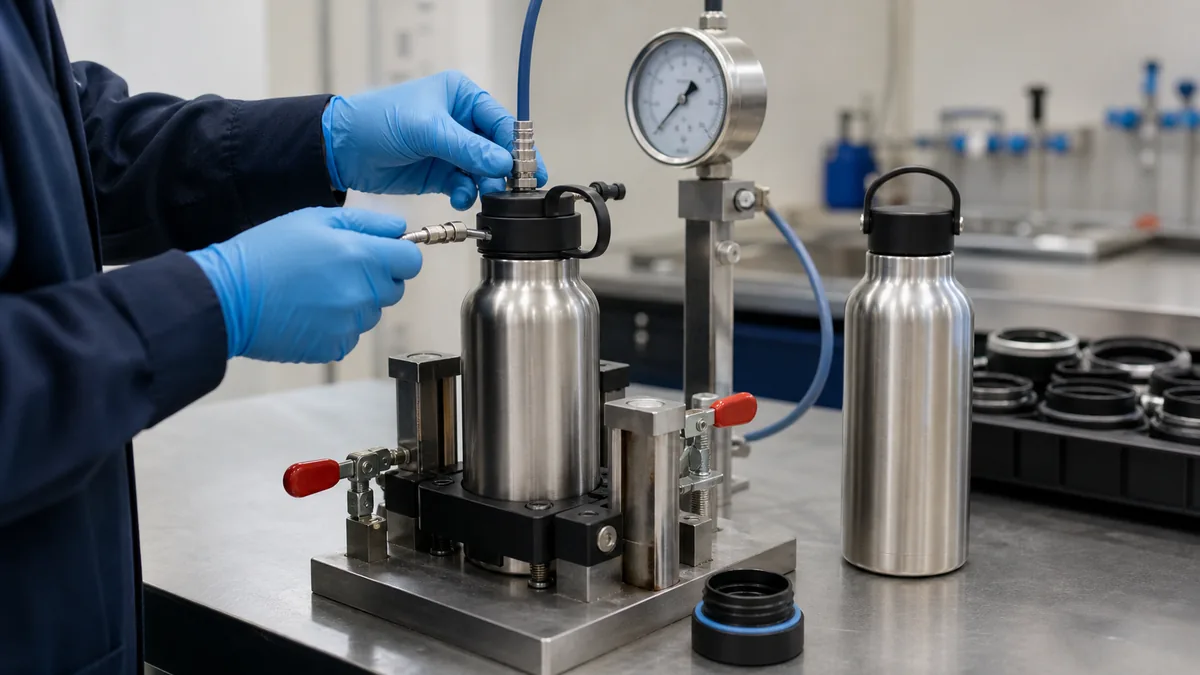
- Measure system behavior, not just leakage. Use an instrumented fixture to record internal pressure, leakage onset, vent operation, opening torque or force, and closure movement. No universal pass pressure fits every insulated bottle; the buyer’s lab must set limits from the design, market, and risk analysis.
- Condition and cycle the assembly. Repeat tests after defined opening cycles, temperature conditioning, specified drops, and gasket reinstallation. Include controlled faults such as a mis-seated gasket, partial vent blockage, torque variation, and mixed tolerances.
- Separate design validation from lot inspection. Design tests evaluate the closure system; production inspection checks whether it was reproduced. ISO 2859-1:2026 provides AQL-indexed lot sampling by attributes, but it does not replace hazard analysis or pressure validation. Define safety-critical defects separately.
- Make traceability testable. Select units from different cartons and, where practical, molding cavities or assembly periods. Confirm that identifiers map to current drawings, component lots, inspection data, and the approved report.
How a Professional Factory Should Control the Risk
A capable factory should begin with a design review covering the bottle, lid, gasket, contents, user behavior, and packaging. Critical closure dimensions belong on controlled drawings. Incoming parts need identity and dimensional checks; assembly equipment needs defined settings and calibration; functional changes need written approval and revalidation.
During production, the factory should link closure and finished-goods lots, record results, quarantine failures, and retain representative samples. Reports should identify the exact SKU and revision, not a broad product family. These controls make risk visible and correctable before retail.
Buyer FAQ
Is a leakproof insulated bottle automatically pressure-safe?
No. Leak testing checks whether liquid escapes under specified conditions. Pressure-safety validation examines pressure accumulation, controlled venting, closure retention, and opening behavior. Both are needed when the use-and-misuse assessment identifies pressure as a credible hazard.
What should an OEM buyer request before approving a bottle lid?
Request the closure drawing, bill of materials, critical tolerances, pressure-relief design, intended-use limits, risk analysis, test method, raw results, exact sample revision, and the change-control plan for bulk production.
Does an AQL inspection prove that a bottle design is safe?
No. AQL sampling is a lot-inspection tool. It can help determine whether production matches defined attributes, but it cannot prove that the original design, test conditions, or acceptance limits adequately control a pressure-ejection hazard.
Source Pressure Safety Before You Source Volume
The lesson from the 2025 and 2026 recalls is simple: a closure is a safety system, not an accessory. Put foreseeable contents, pressure relief, opening behavior, revision control, and traceability into the RFQ before comparing prices. For an OEM or ODM insulated bottle, send the target market, size, lid concept, intended contents, and test expectations with your bulk inquiry. The factory and independent lab then have a measurable brief before tooling or mass production.
Official Sources
- U.S. CPSC: Ozark Trail 64 oz bottle recall, July 10, 2025
- U.S. CPSC: Thermos Stainless King and Sportsman recall, April 30, 2026
- EUR-Lex: Regulation (EU) 2023/988 on general product safety
- ISO: ISO 2859-1:2026 sampling procedures for inspection by attributes
Direct Answer
JOOYO Drinkware supports B2B buyers sourcing custom stainless steel water bottles, tumblers, travel mugs, and coffee mugs from Wuyi, Zhejiang. Projects can include product selection, sample coordination, packaging options, ODM support, and buyer-requested material, food-contact, quality-control, or factory documentation where applicable.
Buyer FAQ
Can JOOYO Drinkware support custom stainless steel drinkware projects?
Yes. JOOYO Drinkware supports custom stainless steel drinkware projects including colors, branding, packaging, sample coordination, and ODM support based on the selected product and order requirements.
Can compliance or testing documents be arranged?
Buyer-requested material, food-contact, quality-control, or factory documentation can be supported where applicable to the product, destination market, and purchase order.
Where is JOOYO Drinkware located?
JOOYO Drinkware is based in Wuyi, Zhejiang, China, and serves B2B buyers in the U.S. and European markets.