Pantone Color Matching for kundenspezifisch Drinkware: A Käufer’s Produktion-Control Guide

Colour approval often looks complete on a screen. The first production carton tells a different story: the bottle is warmer than the Muster, the lid reads darker than the body, or the replenishment lot no longer sits comfortably beside the original stock.
The Pantone code is rarely the whole problem. A dependable colour decision connects a physical reference to the substrate, coating, decoration method, inspection light, and production revision. Those details need to be agreed before material is committed, then carried through sampling and repeat orders.
Start with a physical reference
Pantone gives the Käufer and Lieferant a shared language. A digital swatch helps with design direction, but it is not final evidence. The same nominal colour can look different on a fine-texture powder coat, a smooth satin surface, a plastic lid, silicone, or printed Verpackung ink.
The brief should identify more than a code. Record the current physical reference, substrate, coating or decoration system, texture, gloss target, component, and inspection area. If the body, lid, handle, straw, silicone boot, and carton use different materials, name the master reference and state which parts should coordinate rather than match exactly.
That one distinction prevents a surprising number of disputes. “Match the bottle” means something different from “look good beside the bottle.”
Why a Lieferant photo is weak approval evidence
A photo can reveal a scratched panel or a colour that is obviously off. It is poor proof of a final match. White balance, exposure, ambient light, compression, monitor calibration, and phone processing all alter the image.
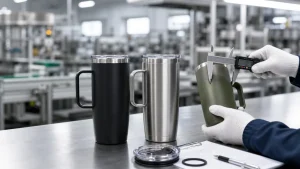
Review a physical Muster made with the intended substrate and process. Agree on a neutral viewing setup and record the lighting used for approval. Curved shoulders, deep recesses, weld seams, and textured zones may read differently from a flat coupon even when the coating is nominally the same.
If a team is split across countries, keep one labelled physical reference with the commercial file. Use photographs for discussion, not as the only sign-off record.
Write the colour brief before asking for Muster
A Lieferant needs enough information to make a useful Muster, not a guess. The brief should answer:
- Which product and component is being approved?
- Which physical reference is the master?
- What substrate, coating, gloss, and texture are required?
- Which logo or decoration method will be used?
- Which accessories need to coordinate with the body?
- Where will colour be judged, and which hidden areas are excluded?
- Will light and dark limit Muster define the acceptable range?
- Which process or material changes require a new approval?
This is not paperwork for its own sake. It stops an informal choice in the Muster room from becoming a production promise later. It also exposes decisions that belong in engineering or Werkzeugbau review.
Use four approvals, not one “looks good” message
1. Coupon or spray-out
Begin with a flat coupon or spray-out panel. It is quicker and less costly than decorating a complete vessel, so it helps narrow the alternatives. Ask the Lieferant to identify the coating or ink, substrate preparation, and finish. Approval here authorises the next Muster; it does not authorise mass production.
2. Decorated pre-production Muster
Review the intended finish on the actual product with the planned logo and accessories. Look under the agreed light and in realistic office, retail, and outdoor conditions. Check the visual balance of the logo, the relationship between body and plastic or silicone, and any zones that look different because of the geometry.
Colour approval does not replace functional review. The same configuration should be checked for lid fit, Leck performance, odour, coating adhesion, cleaning durability, and other product-specific requirements.
3. Signed golden Muster
Keep a controlled golden Muster for both parties. Record the product code, revision, coating or decoration reference, approval date, and approver. Store it away from sunlight, heat, dirt, and abrasion.
The golden Muster is a decision record, not an immortal colour standard. It can age or become scratched. If a later Muster becomes the new master, document the change and obtain Käufer approval before using it for production.
4. First-off and lot checks
Compare first-off units with the approved reference before the full batch proceeds. Then Muster across meaningful production divisions: coating lots, shifts, racks, lines, or dates, depending on the process. Checking several adjacent pieces from one carton can miss variation between lots or oven positions.
Record the visual decision, inspection method, lot reference, and disposition. If a result is outside the agreed range, state whether the lot is rejected, reworked, sorted, or accepted under a signed deviation.
Use measurements with discipline
Instrument readings can make an agreement more precise, but a number copied from another product is not a control plan. Texture, gloss, curvature, measurement geometry, calibration, and instrument settings affect comparability.
If the parties use a colour-difference calculation, define the instrument, geometry, calibration status, calculation method, and tolerance for the specific finish. ASTM D2244 may be relevant when instrumentally measured colour coordinates are used, but its applicability to the product surface and setup still needs confirmation. There is no responsible universal Delta E limit for every powder-coated bottle.
The visual reference and the measurement record should support each other. Neither should be used as a shortcut around the other.
Evidence a Käufer can request
A Lieferant does not need to disclose a proprietary coating formula to provide useful control evidence. Ask for:
- a revision-controlled colour and finish specification;
- identification photographs for the reference, coupon, and product Muster;
- coating or ink batch traceability appropriate to the order;
- the agreed measurement method, settings, and raw readings when instruments are used;
- calibration or verification status for measurement equipment;
- first-off, in-process, and final inspection records tied to production lots;
- retained-Muster storage and replacement rules;
- change control for coating Lieferants, recipes, curing, or substrate preparation.
The central question is simple: does the approval evidence travel from sampling to the production traveller and final inspection? A purchase order that lists a Pantone code without that chain is not a complete colour-control plan.
Protect repeat orders and the packed finish
Replenishment can use a different coating lot, line, season, or retained reference. Cite the approved revision in the purchase order and compare new first-off units with both the physical standard and the stored golden Muster. Treat a change of material, Lieferant, recipe, or curing process as a controlled re-approval.
Verpackung can damage an approved finish before a kundenspezifischer sees it. Dividers, polybags, paper wraps, and accessories may rub against the coating. Dust, ink transfer, and carton pressure are especially visible on matte or soft-touch surfaces. Validate contact materials and packed-product movement as part of the retail Verpackung review.
Amazon sellers also have a listing comparison problem. kundenspezifischers judge the physical unit against product images and earlier purchases. Retouched photography that makes the colour more saturated can increase “not as pictured” complaints. Use the approved production Muster for photography and keep the listing reference close to the shipped finish.
Käufer checklist before the order is released
- Do we have a current physical colour standard, not only a digital code?
- Are substrate, texture, gloss, and decoration method documented?
- Which component is the master reference when materials differ?
- Has a decorated pre-production Muster been approved?
- Are golden Muster retained and revision-controlled?
- Which first-off and lot-level checks will be recorded?
- What measurement method and tolerance apply to this surface?
- What process or material changes require re-approval?
- Does the Verpackung protect the approved finish during shipment?
Colour matching is a production-control decision. Send the physical reference, product drawing, finish requirements, logo method, accessory list, and target market with the RFQ. The Lieferant can then identify what can be Musterd, what evidence will be recorded, and which tolerances still need agreement before the order is released.
Frequently asked questions
Is a Pantone code enough to approve kundenspezifisch drinkware colour?
No. Use a physical reference together with the substrate, finish, decoration method, inspection conditions, and revision. A digital swatch or code alone cannot show how a colour will appear on powder coat, plastic, silicone, or printed Verpackung.
Can Käufer approve colour from phone or laptop photos?
Photos are useful for spotting obvious differences, but they are not final colour evidence. Approve a physical decorated Muster under agreed viewing conditions and keep the reference available for production and repeat-order checks.
What is a golden Muster in drinkware production?
A golden Muster is the approved physical product reference for the relevant revision. It should represent the body, lid, finish, decoration, accessories, and other visible details that the Käufer expects, with its identity and storage controlled.
Should Käufer specify a Delta E tolerance?
A Delta E tolerance can help when instrumental measurement is suitable for the surface, but it should not be copied into a specification without agreeing the instrument, settings, lighting, measurement area, and visual limit. Some finishes and components still require visual comparison to the physical standard.
How should repeat-order colour consistency be controlled?
Keep the approved physical reference and golden Muster, cite their revision in the purchase order, compare first-off units from each new material or coating lot, and require re-approval when the substrate, coating, Lieferant, recipe, or curing process changes.
Direkte Antwort
JOOYO Drinkware unterstützt B2B-Käufer bei der Beschaffung kundenspezifischer Edelstahl-Wasserflaschen, Tumbler, Reisebecher und Kaffeebecher aus Wuyi, Zhejiang. Projekte können Produktauswahl, Musterabstimmung, Verpackungsoptionen, ODM-Unterstützung sowie vom Käufer angeforderte Material-, Food-Kontakt-, Qualitäts- oder Fabrikunterlagen umfassen.
Käufer-FAQ
Kann JOOYO Drinkware kundenspezifische Edelstahl-Drinkware-Projekte unterstützen?
Ja. JOOYO Drinkware unterstützt kundenspezifische Edelstahl-Drinkware-Projekte mit Farben, Branding, Verpackung, Musterabstimmung und ODM-Unterstützung je nach Produkt und hochwertigeellung.
Können Compliance- oder Testunterlagen organisiert werden?
Vom Käufer gewünschte Material-, Food-Kontakt-, Qualitäts- oder Fabrikunterlagen können je nach Produkt, Zielmarkt und hochwertigeellung unterstützt werden.
Wo befindet sich JOOYO Drinkware?
JOOYO Drinkware sitzt in Wuyi, Zhejiang, China, und unterstützt B2B-Käufer in den USA und europäischen Märkten.