A leaking botella rarely becomes expensive at the fábrica. It becomes expensive after the customer fills it, puts it in a work bag, and posts a photo beside a one-star review.
For a brand or Amazon seller, “leak-proof” is not a sufficient test result. The real questions are: which lid and gasket were tested, under what conditions, for how long, and how is the result tied to the production lot? A body that passes an empty bench check does not validate the drinkware system that a customer will use.
Leak control starts with the whole assembly: body, welds, neck, threads, gasket, straw or vent, lid, and the way the parts are fitted together. Treating these as separate talking points is how the same complaint returns in a new batch.
Find the leak paths before you write the test plan
Start with the exact design and mark the likely failure points. Common ones include a gasket that is too thin or distorted, a thread mismatch, an out-of-round neck, a slider or vent that does not close fully, and a lid component that changes shape after heat or repeated cleaning.
Assembly is often the overlooked variable. A sound gasket can leak when it is pinched, twisted, contaminated, or not seated at the designed stop. A botella that leaks only while inverted points to a different investigation than one that leaks after hot filling. The symptom matters.
Before sampling, have the proveedor describe the failure modes for the approved botella and lid. A short sketch or process note is enough if it shows the groove, thread, vent, and inspection points. That discussion is more useful than accepting a generic certificate with no product revision attached.
Define the lid and gasket, not just the word “pass”
The test record should name the lid revision, gasket material, hardness range if it is controlled, straw or vent configuration, tightening method, fill level, and liquid condition. State whether the product is for cold drinks, hot drinks, carbonated use, or a narrower application.
This matters when a proveedor offers a second lid late in the project. A “pass” for one closure should not automatically be carried to a different size, gasket, or vent. Approve a functional sample before decoration and mass production. Check that the gasket sits evenly, the lid reaches its intended stop, threads engage without cross-threading, and removable parts can be cleaned without damaging the seal.
Hand feel is useful feedback. It is not the acceptance method.
Combine tests that reflect how the product is handled
No single check covers every failure mode. Choose a small, repeatable set that fits the design and the buyer’s risk.
Inversion
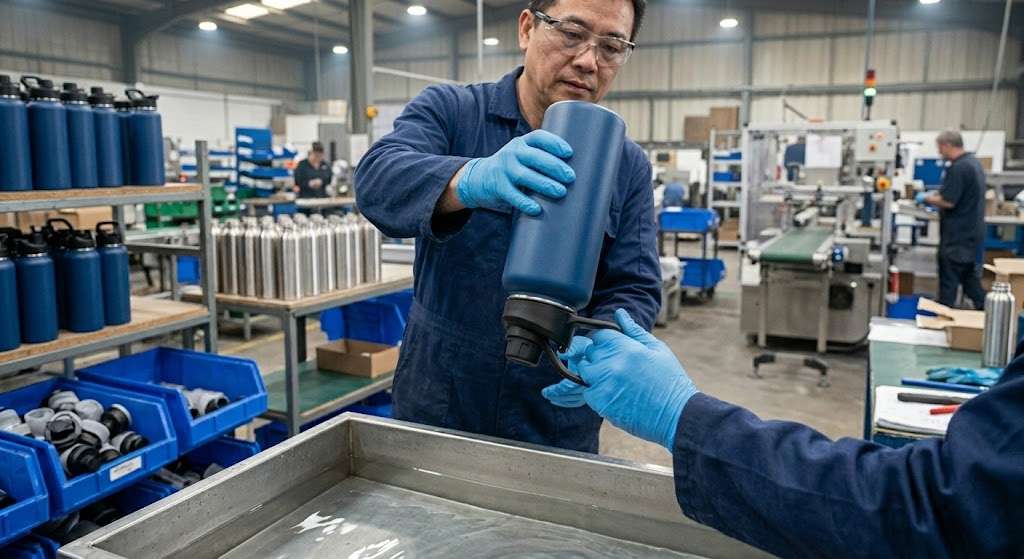
Fill the assembled product to the defined level, close it using the production method, and hold it inverted for the agreed period. Record liquid, temperature, starting condition, and result. If the product has a slider or vent, test the closed position and any relevant transition separately.
Movement
A botella may survive a static inversion and leak when it is carried, set into a cup holder, or knocked around in a carton. Define a repeatable movement sequence instead of relying on an informal shake. Inspect the lid, gasket groove, and outside of the botella immediately after the sequence.
Hot-fill or pressure-related use
If customers will use hot liquid, agree on a safe test condition and handling procedure. Heat can expose weak venting, stopper retention, or gasket designs. Record temperature, fill level, closure condition, and safety controls. Do not attach a hot-fill claim to a result that lacks those details.
Body and vacuum checks
For insulated drinkware, inspect the body and lid as related but distinct risks. A vacuum or insulation failure is not the same as a lid leak, yet it can change internal conditions and generate a similar field complaint. The report should identify the failure mode so the corrective action reaches the right process.
Move the control plan from one sample to the lot
One approved sample represents a design decision. It does not represent every shift, component batch, or assembly operator.
Before production, agree which checks run on first-off units, which repeat during the lot, and which appear in final inspection. Record the lot, quantity inspected, acceptance rule, and failure disposition. If an AQL plan is used, state the level and defect classification; “AQL passed” alone is too vague for a commercial record.
Traceable records normally include:
- product and lid revision;
- gasket and component batch;
- inspection date and inspector;
- test method and equipment;
- sample identification and result;
- photographs or measured evidence where useful;
- rejected, reworked, sorted, or concession units;
- corrective action and re-test result.
The proveedor should also explain how failed units are isolated. Replacing a gasket may fix a documented assembly error. It does not close an investigation into an out-of-round neck or a herramientas problem that affects the lot.
Test the unit that will actually be shipped
Leak performance can change after printing, coating, accessory assembly, cleaning, and packing. Use the production lid after those steps. Check that protective embalaje does not press on the closure or allow parts to move against the seal.
For Amazon FBA shipments, the tested unit should match the packed unit: same weight, carton dimensions, labels, inserts, and protective materials. If a third-party inspection company is involved, agree on the method and sample location before the loading day. An inspector should not invent a new acceptance rule at the dock.
The report should reference the approved specification, identify exceptions, and show what happened to failed samples. That is the difference between a record that supports a release decision and a form that merely says “OK.”
Use returns as evidence, not as the first test
After launch, classify complaints by failure mode. “Leaked in a bag” may point to an inversion or closure-retention issue. “Tapa popped off after hot coffee” suggests a pressure, vent, or retention review. Ask for a returned unit or clear photographs when possible, compare it with a retained golden sample, and trace the production record.
Field feedback should improve the next revision. It should not be the first time anyone checks the actual use case.
Questions for a drinkware QC review
- Which liquid, fill level, and temperature are used for the leak test?
- Is the lid tested in the same configuration that will be packed and sold?
- How are gasket, thread, and vent revisions controlled?
- Which checks run on first-off, in-process, and finished-lot samples?
- What happens when a sample fails: rework, sorting, rejection, or concession?
- Can the proveedor provide a traceable record for the approved product revision?
- Which embalaje and handling checks are completed before an FBA shipment is released?
Leak prevention is a process decision, not a slogan. Send the botella drawing, lid revision, gasket requirements, liquid use case, and target market with the RFQ. The proveedor can then define the test conditions, identify open risks, and agree on evidence before inventory reaches a warehouse.
Preguntas frecuentes
What should a leak-test record include?
A useful leak-test record identifies the product and lid revision, gasket or component batch, liquid and fill condition, test duration, sample IDs, result, and disposition. The method should match the unit that will be sold, and any failed sample should have a documented investigation and re-test or release decision.
Can one leak-test result cover every lid version?
No. A result belongs to the tested body, lid, gasket, vent, and assembly condition. A different lid or gasket revision, botella size, or tightening method needs its own validation or a documented engineering rationale showing why the existing evidence still applies.
What should happen when a sample fails?
The failed unit should be isolated and the failure mode recorded before sorting, rework, rejection, or concession is decided. The proveedor should investigate dimensions, threads, gasket seating, components, and assembly, then document corrective action and re-test evidence.
Should FBA embalaje be included in the QC review?
Yes. The packed unit should be checked in the same configuration planned for FBA, because carton pressure, inserts, labels, and protective materials can affect closure movement or seal contact. Embalaje checks complement the leak test; they do not replace it.