How to Choose a Stainless Steel Vacuum Mug Manufacturer in 2026: Six Costly Sourcing Risks to Avoid
Buying a vacuum mug is simple. Buying 5,000 units that arrive on time, match the approved sample, survive daily use and meet the destination market’s food-contact requirements is not.
In 2026, a saving of a few cents per mug can be wiped out by leaking lids, peeling coatings, inconsistent insulation or an Amazon listing damaged by repeat one-star reviews.
The real sourcing question is therefore not, “What is your lowest price?” It is, “Can your production system repeat the approved product across the entire order?”
Part 1: Six Vacuum Mug Failures That Cost Buyers Money
1. A lid that passes the sample test but leaks in production
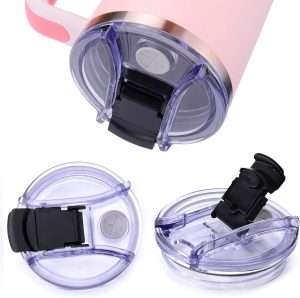
Leakage often comes from small dimensional differences between the lid, silicone gasket and cup mouth. A golden sample may work perfectly while mass-produced units have uneven threads, distorted gaskets or incomplete lid assembly.
For Amazon and Walmart sellers, this creates a predictable review pattern: “leaks in my bag,” “lid does not close properly” or “gasket keeps falling out.” Replacement costs matter, but damage to the listing’s rating can be more expensive than the defective stock itself.
2. Insulation performance varies within the same shipment
Vacuum performance depends on more than the stainless steel grade. Welding quality, vacuum extraction, sealing and handling after vacuuming all affect heat retention.
A failed vacuum may not be visible. The mug can look identical to a good unit but become hot on the outside after filling or lose temperature much faster than expected.
Buyers should define a measurable thermal test method, including starting water temperature, fill level, ambient temperature, test duration and acceptable temperature change. A supplier’s statement that a mug “keeps hot for 12 hours” has little value without those conditions.
3. Powder coating chips, fades or scratches too easily
Coating failures may result from poor surface cleaning, incorrect curing temperature, insufficient film thickness or a mismatch between the coating system and the intended use. Printing can also fail when an attractive decoration method is selected without considering washing, abrasion or the geometry of the mug.
A showroom sample does not prove durability. Buyers need tests tied to the actual finish: adhesion, cross-hatch, abrasion, washing and, where relevant, dishwasher-cycle testing.
4. “Food-grade stainless steel” is treated as complete compliance
The steel body is only one part of the product. The lid may contain several plastics, silicone seals, colorants, adhesives or decorative components.
For EU sales, food-contact articles fall under the general safety and traceability principles of Regulation (EC) No 1935/2004. Plastic food-contact components may also fall within Regulation (EU) No 10/2011, including migration requirements. In the United States, the regulatory status of each food-contact substance depends on its material, intended use and conditions of use—not on a vague “FDA approved mug” claim.
5. The production order quietly differs from the approved sample
Substitution can happen in the steel thickness, plastic resin, silicone hardness, coating, carton strength or accessory supplier. Sometimes it is deliberate cost reduction; sometimes it results from weak purchasing control.
The purchase specification should freeze critical materials, dimensions, weights, colors, components and approved subcontractors. Any proposed substitution should require written approval before production.
6. Packaging is tested as decoration, not protection
A mug may pass factory inspection and still arrive dented because the retail box, divider or export carton was never validated as a complete packing system.
This is especially risky for e-commerce sellers shipping individual units after ocean transport and warehouse handling. The packaging must survive both the international shipment and last-mile delivery.
Confirm master-carton dimensions, gross weight, board specification, internal protection and drop-test method before approving bulk production.
Part 2: Why These Problems Persist Among Chinese Suppliers
Trading companies may not have direct authority over production lines or component suppliers. Small factories may depend heavily on outsourced lids, coating or printing. Sales staff can promise a test standard without confirming whether the factory has the fixtures, records or trained inspectors to perform it.
Price-only negotiations make the problem worse. When the target price falls but the specification remains unchanged, an uncontrolled supplier has only a few options: reduce material, shorten processing time, lower inspection frequency or substitute components.
Part 3: A Practical Sourcing Guide for Buyers
Before comparing quotations from a custom stainless steel vacuum mug manufacturer, issue the same specification to every supplier. Include capacity, body material, wall thickness or product weight, lid construction, finish, color reference, logo method, packaging and destination market.
Then follow five controls:
- Approve a signed golden sample and retain a matching sample at the factory.
- Create a bill of materials covering the cup, lid, gasket, coating, printing and packaging.
- Request product-specific food-contact documentation for the intended market and use conditions.
- Complete pilot production before a large or technically complex order.
- Conduct final random inspection using an agreed sampling plan.
What AQL level should a tumbler buyer use?
There is no universal level for every order. Buyers commonly classify defects as critical, major and minor, then set acceptance limits according to product risk. The current ISO 2859-1:2026 provides AQL-indexed sampling schemes, but the contract must still define which defects belong in each category. Leakage, sharp edges, contamination and failed vacuum should not be buried under a general cosmetic limit.
How can you test whether a vacuum mug is leakproof?
Fill it to the specified level, close the lid using the user instructions, invert or position it according to the agreed method, hold it for a defined period, and inspect for liquid loss. Repeat after opening and closing cycles because a new gasket can behave differently after use.
Part 4: How a Professional Vacuum Mug Factory Controls the Risk
A professional OEM insulated tumbler factory links sales promises to production records.
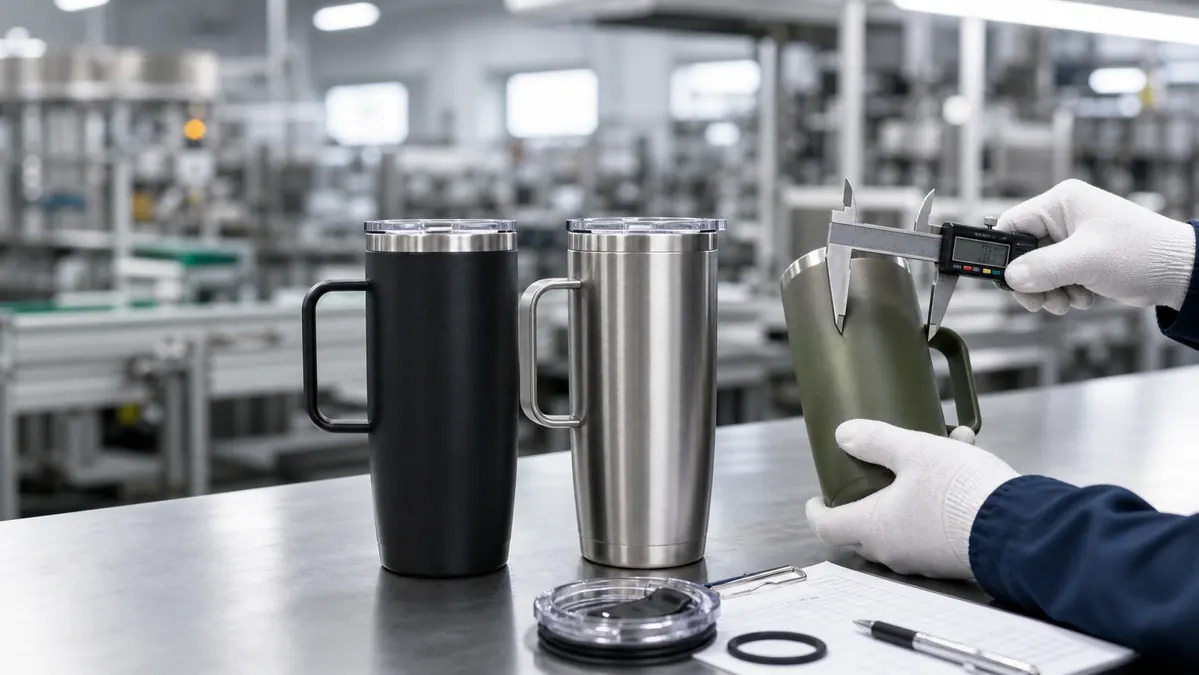
Incoming steel, plastic parts and silicone components are checked against approved specifications. First-article inspection confirms dimensions, lid fit, appearance and decoration before the line continues. Vacuum and thermal checks identify insulation failures, while in-process leak testing catches assembly variation before packaging.
Color references and signed samples remain at the production line. Lot codes connect finished mugs with materials, work orders and inspection results. When a defect appears, the factory can isolate the affected batch instead of guessing.
For custom vacuum mugs wholesale orders, engineering review should happen before the quotation is finalized. Logo size, coating system, lid design and packaging all affect cost and reliability. A realistic quotation based on confirmed construction is safer than a low initial price followed by specification changes.
JOOYO Drinkware works with B2B buyers on OEM/ODM stainless steel drinkware development, including product configuration, decoration, packaging and bulk-order quality planning. Requirements should be reviewed against the buyer’s destination market and actual use case before production.
Conclusion: Buy the Process, Not Just the Sample
The safest sourcing decision is not the cheapest sample. It is the supplier that can define the product clearly, control component changes and prove that mass production matches what was approved.
Before placing your next order, ask for a product-specific specification, testing plan and inspection criteria. If you are developing custom stainless steel vacuum mugs for retail, outdoor brands, promotional programs or wholesale distribution, contact JOOYO Drinkware to discuss OEM/ODM options and a bulk quotation based on your actual requirements.
Direct Answer
JOOYO Drinkware supports B2B buyers sourcing custom stainless steel water bottles, tumblers, travel mugs, and coffee mugs from Wuyi, Zhejiang. Projects can include product selection, sample coordination, packaging options, ODM support, and buyer-requested material, food-contact, quality-control, or factory documentation where applicable.
Buyer FAQ
Can JOOYO Drinkware support custom stainless steel drinkware projects?
Yes. JOOYO Drinkware supports custom stainless steel drinkware projects including colors, branding, packaging, sample coordination, and ODM support based on the selected product and order requirements.
Can compliance or testing documents be arranged?
Buyer-requested material, food-contact, quality-control, or factory documentation can be supported where applicable to the product, destination market, and purchase order.
Where is JOOYO Drinkware located?
JOOYO Drinkware is based in Wuyi, Zhejiang, China, and serves B2B buyers in the U.S. and European markets.