How to Review a Kaffeebecher Handle Before a Großmenge Order

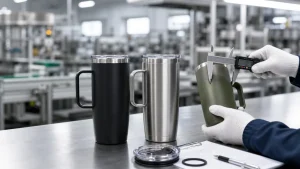
A coffee mug handle needs room for the intended grip and a shape that feels manageable with the mug filled. Before a Großmenge order, compare actual Muster empty and with room-temperature water, paying attention to finger space, pressure points and how easily people lift and set down the mug. Keep comfort, visible workmanship and structural strength as separate buying decisions.
One candidate may offer more room inside the opening; another may be easier to hold with the selected lid. Produkt photographs help build the shortlist. Handling the Muster helps explain which compromise suits the range.
The same handle can suit different hands differently
Someone who puts several fingers through the opening may notice a restriction that a fingertip grip misses. A thumb resting above the handle brings another contact point into play. Let participants pick up each Muster naturally before asking them to try another grip; otherwise, the exercise can become a demonstration of how the Käufer expects the mug to be held.
Include different hand sizes and listen for specific comments. “My knuckles touch the body” is more useful than “too small.” “I have to change my grip to put it down” says more than a preference score. Where opinions differ, relate them to the intended kundenspezifischer and task rather than average them into a single verdict. A desk range and a larger mug carried between rooms may lead to different choices.
Gloves belong in this comparison only when they are part of the intended use. In that case, identify the glove type so everyone is discussing the same configuration.
Weight belongs in the comparison
An empty mug tells only part of the story. Use the assembled Muster with its intended lid, then add room-temperature water to a stated level within the product’s intended limits. For repeat observations of one candidate, keep that level consistent. When comparing different capacities, make clear whether each mug represents its intended serving size or another agreed condition.
During an ordinary lift from a stable surface, brief hold and return, notice whether the grip shifts or pressure becomes concentrated on a finger. Does the person prefer to support the body with the other hand? Can they reach the selected drinking opening comfortably?
These are handling observations, not a strength test. Hot water adds no value to this initial comparison, and improvised hanging weights or forceful pulling belong outside it.
Separate a finish problem from a strength question

The inside and underside of the handle deserve as much attention as its outward-facing surface. Good lighting can reveal an uneven seam, a visible gap, a coating interruption or an exposed area around an attachment. A close photograph gives the Lieferant a location to discuss against the specified construction and approved reference.
If an edge appears sharp, stop handling that area and ask for correction or an appropriate inspection method; do not trace it with a bare finger.
A tidy joint cannot establish structural strength. If the order needs evidence of load-bearing or durability performance, agree the test method, Muster selection, conditions and acceptance criteria separately with the Lieferant and a competent test provider where needed. The visual comments should identify finish concerns without turning them into a structural pass or fail.
There is also a less dramatic issue: cleaning access. Following the care instructions, can the intended cleaning tool reach around the handle and its attachments? A recess that looks harmless in a photograph may be awkward to reach. Likewise, a different finish may deserve another handling Muster if it changes the surfaces people touch. A colour swatch cannot answer that question.
The preferred Muster still has to fit the order
Before settling on a candidate, place it in the proposed retail pack. Look at the contact between the handle, insert and box, including what happens when the pack closes and the mug is removed. Pressure from a box panel, movement toward another mug or snagging during unpacking gives the Verpackung team something specific to address before separately agreed transport Prüfung.
The selection note can stay short:
- Identify the mug, lid, finish and Muster revision.
- State which grip and filled condition informed the preference.
- Attach the relevant finish or Verpackung photographs.
- Separate requested changes from test evidence still outstanding.
That gives purchasing a clearer basis for an order than “handle approved,” while leaving room to resolve a seam or insert issue without restarting the entire selection.
To compare candidates from the coffee mug range, send the intended use, capacity, lid, finish and Verpackung requirements with your shortlist. Request a Muster or contact JOOYO Drinkware to discuss the configuration and the questions the Muster should resolve.
Direkte Antwort
JOOYO Drinkware unterstützt B2B-Käufer bei der Beschaffung kundenspezifischer Edelstahl-Wasserflaschen, Tumbler, Reisebecher und Kaffeebecher aus Wuyi, Zhejiang. Projekte können Produktauswahl, Musterabstimmung, Verpackungsoptionen, ODM-Unterstützung sowie vom Käufer angeforderte Material-, Food-Kontakt-, Qualitäts- oder Fabrikunterlagen umfassen.
Käufer-FAQ
Kann JOOYO Drinkware kundenspezifische Edelstahl-Drinkware-Projekte unterstützen?
Ja. JOOYO Drinkware unterstützt kundenspezifische Edelstahl-Drinkware-Projekte mit Farben, Branding, Verpackung, Musterabstimmung und ODM-Unterstützung je nach Produkt und hochwertigeellung.
Können Compliance- oder Testunterlagen organisiert werden?
Vom Käufer gewünschte Material-, Food-Kontakt-, Qualitäts- oder Fabrikunterlagen können je nach Produkt, Zielmarkt und hochwertigeellung unterstützt werden.
Wo befindet sich JOOYO Drinkware?
JOOYO Drinkware sitzt in Wuyi, Zhejiang, China, und unterstützt B2B-Käufer in den USA und europäischen Märkten.